
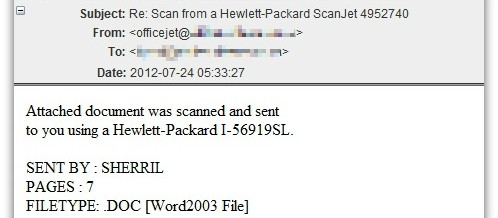
Malware designers are sending out bogus emails that appear to come from an HP scanner device on your network. They contain an attachment contained in a .zip file, and when the file is expanded it turns out to be an executable for a Trojan horse. So be on the lookout for this type of email and keep yourself safe. The full story is on Sophos.
On the Internet there are two main ways of getting a malware infection – links or attachment on emails, or from visiting fake, rogue, or compromised websites. So browser security has become an important consideration, perhaps the most important consideration, when deciding what browser to use.
Microsoft will be releasing Internet Explorer 10 with Windows 8 in the fall. IE 10 will be available for Windows 7 users by download. Several major changes in the browser will improve its overall security. ...
Continue Reading →AUG
This story is very very freaky. Here is the link to the original article in Wired. Exploiting security flaws on Amazon’s and Apple’s web sites, Mat Honan’s Google account, Twitter account, and Apple ID accounts were breached, and and with it his email accounts. The hackers then erased all the data in his MacBook and iPhone. None of this information was backed up, and Mat lost everything, including every picture he had of his newborn daughter.
This was possible ...
Continue Reading →AUG
In an article on Sophos, the question was posed “Is security training a waste of time?” There were some examples of training with poor outcomes. 80% of West Point cadets given 4 hours of computer security immediately fell for a test phishing scam. Employees at internet security firm RSA opened an infected XML attachment to an email that allowed their “secure” network to be breached by real-life hackers. At the end of the article, it is suggested that ...
Continue Reading →AUG
I recent survey by several leading software manufactures found that only 40% of users accepted alerts requesting them to download an install an upgrade, update, or security patch, even when the updates are free of charge. The reasons given most often were:
- The end users didn’t know if the alert was valid or not, were concerned the alert was fraudulent, and that they risked downloading malware or some else as bad.
- There was no perceived or explained benefit to the end ...
AUG
Here’s a fun story from Sophos of a Pennsylvania mom who hacked school district computers in order to improve her children’s grades. She did this while working as an employee of the school district, so this in not quite the feat you might think it is. Nevertheless, she was able to access a lot of other secure personal and payroll records for the district, using the Superintendents user ID and password. Point being that you never know who ...
Continue Reading →AUG
Where does all the spam come from? Well, almost half (49.7%) of it originates somewhere in Asia, with India leading the pack at 11.4%. This does not mean that Indians or other Asians are the “perpetrators.” What this means is that computer users in Asian have become unwitting accomplices after having their poorly secured or unsecured computers hacked and added to some cyber-criminal’s botnet.
Here are the top 10 Spam relaying countries in the world for April to June 2012. They ...
Continue Reading →AUG
It has been nearly 3 years since Windows 7 was launched, and it has finally surpassed the 11 year old and somewhat long in the tooth Windows XP in percentage of Windows computers in use. Windows 7 has a 42% share with windows XP falling to 41% as users replace their older systems. Windows Vista, never very popular with users, has a 7% share, down from its highest share of 13%. It is expected that Windows 7 with achieve 48% ...
Continue Reading →JUL
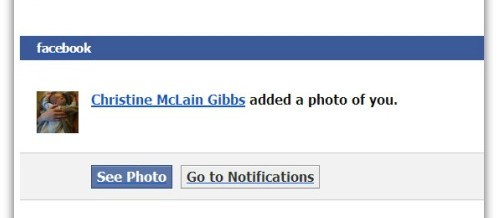
Malware is spreading on the Facebook platform posing as emails from Facebook saying you have been tagged in a photo. Clicking on the link will redirect you to a malware download site, and then almost immediately to Facebook, so you may not even know that this has happened. Please be careful opening these emails. It is usually a better course of action to simply go to your Facebook page and search for the photo tag there. Of course, in this ...
Continue Reading →JUL
Malware is spreading on the Facebook platform posing as emails from Facebook saying you have been tagged in a photo. Clicking on the link will redirect you to a malware download site, and then almost immediately to Facebook, so you may not even know that this has happened. Please be careful opening these emails. It is usually a better course of action to simply go to your Facebook page and search for the photo tag there. Of course, in this ...
Continue Reading →JUL